How visitor recognition becomes bot detection
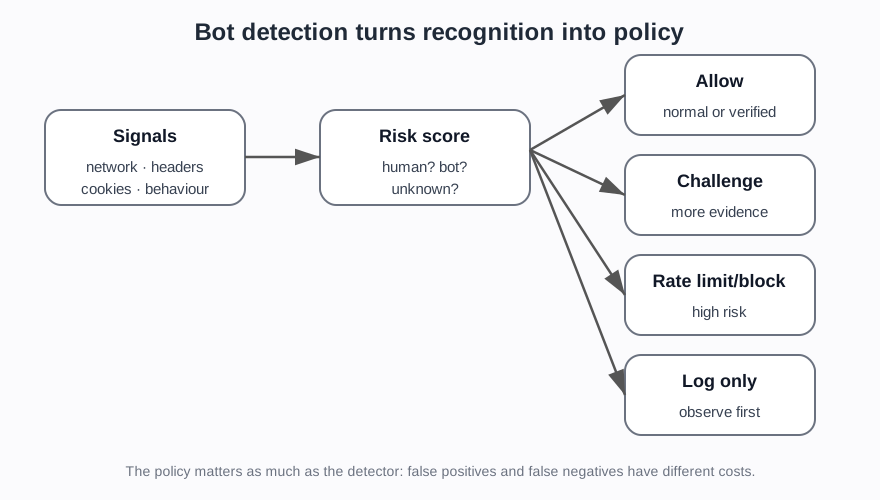
Plain explanation
Bot detection is not usually a perfect yes/no decision.
It is usually a risk judgement based on many signals.
The question is not only:
Is this a bot?
It is often more like:
What kind of traffic is this, how risky is it, and what should the site do with it?
Four broad traffic categories
A website may want to separate traffic into rough categories:
Normal human users
People browsing, logging in, buying, reading, or using the site normally.Good bots
Search engines, monitoring tools, accessibility tools, partner crawlers, or verified agents that the site wants to allow.Unknown automation
Scripts, crawlers, browser automation, scraping tools, or agents whose purpose is unclear.Bad bots / abusive automation
Credential stuffing, scraping, fake account creation, scalping, carding, inventory hoarding, spam, fraud, or account takeover.
Common signal groups
Bot systems may use:
- IP and network reputation
- ASN, datacentre, residential, mobile, VPN, or proxy classification
- request headers
- cookies and session history
- browser/device fingerprints
- TLS or protocol fingerprints
- JavaScript challenge results
- mouse/keyboard/touch behaviour
- request timing and rate
- account history
- endpoint context, such as login versus public page
- known good bot verification
- known bad fingerprints or detection IDs
From signal to action
A bot system may respond in different ways:
- allow
- block
- rate limit
- challenge
- ask for stronger authentication
- log only
- serve different content
- skip protection for verified bots
- send a risk score to the origin application
This matters because “bot detection” is not just detection. It is also response policy.
Why false positives matter
A false positive means a real user is treated as a bot.
That can block customers, break login, stop purchases, or damage trust.
This is why many systems use risk scores and graduated responses instead of always blocking.
Why false negatives matter
A false negative means abusive automation is allowed through.
That can lead to scraping, account takeover, fake accounts, payment fraud, scalping, inventory hoarding, or inflated infrastructure cost.
Why attackers adapt
If a website blocks obvious scripts, attackers may move to:
- realistic headers
- browser automation
- stealth plugins
- undetected drivers
- residential proxies
- CAPTCHA solvers
- cloud browsers
- persistent profiles
- AI browser agents
That is why the project needs a simple-to-complex automation taxonomy.
A vendor saying it uses a signal is useful evidence that the signal exists in production products. It is not, by itself, proof of accuracy, prevalence, false-positive rate, or real-world harm.
What the newer evidence adds
The newer evidence broadens this page from classic “bot detection” into traffic governance.
Cloudflare sources add bot scores, Detection IDs, Turnstile, verified bots, AI-bot controls, and endpoint-specific policy (Cloudflare Bot Management; Cloudflare Turnstile; Cloudflare Detection IDs). DataDome, HUMAN, Kasada, Arkose, Thales, and Akamai-style sources add production-facing categories of abuse and mitigation (DataDome / HUMAN / Kasada / Arkose; Thales / Akamai). OWASP provides the broad threat taxonomy (OWASP Automated Threat Handbook). Academic studies help explain specific signals such as fingerprinting and behavioural checks.
The page should therefore avoid a simplistic story where bot detection means “find bots and block them”. The better framing is:
classify traffic, estimate risk, choose a proportionate response, and keep the cost of mistakes visible.
Project use
This page should introduce the advanced evidence set:
- OWASP automated-threat categories
- Cloudflare bot scores and Detection IDs
- Cloudflare Turnstile and AI-bot controls
- DataDome intent-based detection
- HUMAN cyberfraud and agentic traffic
- Kasada proof-of-execution and retooling
- Arkose dynamic challenges
- academic behavioural and fingerprinting studies
- automation supply-side sources
Sources used on this page
- OWASP Automated Threat Handbook — OWASP / Watson, C., & Zaw, T. (2026). Automated Threat Handbook: Web Applications v1.3 (
SRC-027). - Cloudflare Bot Management — Cloudflare (2026). Bot Management documentation (
SRC-003). - Cloudflare Turnstile — Cloudflare (2026). Turnstile — Overview (
SRC-055). - Cloudflare Detection IDs — Cloudflare (2026). Detection IDs (
SRC-056). - Cloudflare bot solutions overview — Cloudflare (2026). Bot solutions — Overview (
SRC-058). - DataDome / HUMAN / Kasada / Arkose — Defender-vendor material on bot management, intent, challenges, proof-of-execution, and agentic traffic.
- Thales / Akamai — Vendor telemetry and trend reports on bad-bot and financial-services attack activity.
Foundations navigation
Previous: 06. How websites recognise visitors
Next: 08. Automation techniques: from scripts to browser agents