How vendors turn fingerprints into stable IDs
A vendor “visitor ID” or “device ID” is not a fingerprint. It is the output of a matching process that tries to link successive, slightly different fingerprints to the same browser over time. This experiment reconstructs that process at four levels of sophistication and measures the two errors it can make — and shows that vendors only ever publish one of them.
The point is methodological, not operational. The data is synthetic, the drift and cloning rates are plausible guesses rather than measured values, and the browsers are distinguishable (or not) by construction. The experiment is useful for seeing how the machinery works and where its parameters bite. It is not evidence about any real vendor’s accuracy, and every number below should be read as qualitative: the ordering of the methods and the mechanisms behind their failures are the content, not the specific rates.
This investigation follows directly from the identifier-graph and synchrony experiment. That page treated a vendor device_id as one identifier among several feeding an account graph. This page asks the obvious next question: where does that device_id come from, and how much should a shared one be trusted as evidence that two accounts are the same device?
Two errors, not one
Every identification method assigns an ID to each visit. There are two ways to get it wrong, and they pull in opposite directions.
- False split. A returning browser is given a different ID from the one it had last time, so one real device is fragmented into several IDs. This is what happens when a browser’s fingerprint drifts — a version update, a new font, a changed monitor — and the method fails to recognise it as the same device.
- False merge. Two different browsers are given the same ID, so distinct devices are fused under one identity. This is what happens when two devices are clones — most importantly, stock mobile phones, which present near-identical fingerprints.
The asymmetry that runs through this whole page: drift causes splits, clones cause merges, and reducing one tends to increase the other. A method tuned to tolerate drift (so it keeps linking across changes) will also tolerate clones (so it fuses devices that merely look alike).
This matters for account clustering because the two errors corrupt a graph in opposite ways. A false split means one bot device appears as several visitor IDs — the ring fragments, and identifier edges are lost. A false merge means several unrelated devices share one visitor ID — spurious edges appear, and innocent accounts get pulled into a cluster. For abuse detection, false merges are usually the more dangerous error, and as we will see they are concentrated exactly where the public evidence is weakest.
Commercial vendors typically define accuracy as the share of returning visitors correctly recognised as returning. In the language above, that is 1 − false-split rate. It says nothing directly about the false-merge rate — the rate at which different devices are fused — which is the error that poisons downstream clustering. The two trade off against each other, and the published figure is the flattering side of the trade-off. This is not an accusation of bad faith; it is a statement about what a single recall-style number can and cannot tell you.
Background: what a fingerprint ID actually is
It helps to separate two architectures that are often conflated, because they deserve different amounts of trust as a clustering edge.
Client-side hashing is the open-source pattern. A script queries browser attributes — canvas rendering, WebGL strings, installed fonts, screen geometry, timezone, audio-stack quirks — concatenates them, and hashes the result into an ID in the browser itself. The academic lineage runs from Eckersley’s Panopticlick study (2010) through Laperdrix et al.’s canvas/WebGL work (2016). The structural weakness is brittleness: change any input and the hash changes completely, so the ID is exact-match-or-nothing. No commercial vendor ships this as their product, for reasons this experiment makes concrete.
Server-side probabilistic matching is the commercial pattern. The client script becomes a signal collector; the ID is assigned server-side by a matching process that fuzzy-matches across attributes to survive drift, layered with deterministic anchors (signed cookies, device storage) and network-side signals invisible to the page (TLS/JA3-style handshake fingerprints, IP and geolocation analysis). The best public academic anchor for the matching half is FP-STALKER (Vastel et al., IEEE S&P 2018), which frames exactly this problem — fingerprints drift, so maintaining a stable ID means linking successive fingerprints to the same browser — and compares a hand-tuned rule engine against a machine-learned matcher.
The four methods below are deliberately labelled by how much they are documented versus inferred, because they do not all rest on the same evidence:
- Method A (exact hash) is documented. The open-source library works this way and the code is inspectable.
- Methods B and C (rule chains, ML matching) are literature-grounded reconstructions. FP-STALKER describes both a rule-based and an ML-based matcher; these are our simplified versions of that idea, not any vendor’s actual code.
- Method D (anchored hybrid) is inference from vendor documentation. Vendors state that they layer signed cookies and storage with fingerprinting; the specific logic here is our reconstruction of what that layering buys.
The commercial matching layers themselves are closed. The architecture can be described with confidence; the specific matching rules and error rates of any named product cannot, and are not claimed here.
Synthetic data design
The generator must produce both phenomena that make identification hard, or the methods cannot be told apart.
Drift. Each browser’s attributes change over time. Between visits, a browser may bump its version, update its OS, install a font, change screen resolution, or travel to a new timezone, each with a small per-day probability. Drift is what makes a returning browser look new.
Clones. Desktops are drawn from fifteen templates but given individually distinctive font sets and GPU variants, so each of the 150 desktop browsers has a unique starting fingerprint. The 150 mobile browsers are drawn from four stock templates with identical browser-observable attributes, so they collapse to just 15 distinct fingerprints. That is the clone pressure, and it is deliberately severe.
# Simplified from generate_fingerprints.py
# Desktop: distinctive fonts + GPU -> unique
t.update(
    browser_version=int(rng.integers(120, 126)),
    gpu=rng.choice(["nvidia_a", "amd_a", "intel_a", "apple_m", ...]),
    fonts=f"fontset_{rng.integers(0, 10**6):06d}",   # individually distinctive
)
# Mobile: one SoC, one font set across all stock phones -> clones
t.update(
    gpu="soc_std",
    fonts="fontset_mobile_std",                       # identical everywhere
)
Each visit also carries an intermittent first-party cookie. It is cleared on roughly 3% of visits and hidden on about 10% (private browsing). This cookie plays two roles, mirroring real vendor practice: it is the deterministic anchor Method D uses, and it is the ground-truth label Method C trains on. That second role has a sting in the tail, covered below.
The run used here produced 8,119 visits from 300 browsers over 119 days, with about 9.8% of visits in private mode.
- Fingerprint: the collection of browser/device attributes observed on one visit.
- Attribute / signal: one component of a fingerprint, such as the canvas hash, font set, or screen size.
- Drift: gradual change in a browser’s fingerprint over time, from updates and configuration changes.
- Clone: two distinct devices that present the same (or near-identical) fingerprint. Stock mobile phones are the canonical case.
- Chain: a sequence of visits the method believes came from the same browser. The assigned ID is the chain.
- Hard constraint: an attribute that must agree for two visits to be the same browser (OS family, device type) or may only change in one direction (browser version never decreases).
- Soft attribute: an attribute allowed to differ, at a cost (fonts, screen, timezone, canvas).
- Deterministic anchor: a stored value carried by the browser — a signed cookie or storage entry — that identifies it directly, independent of how unique its fingerprint is.
- Entropy: loosely, how much identifying information a fingerprint carries. Stock mobiles are low-entropy; a desktop with an unusual font set is high-entropy.
The four methods
All four assign an ID to every visit; they differ only in how much they reason about drift and clones.
A. Stateless exact hash
The documented open-source pattern. Concatenate all attributes, hash, done. The code is trivial, and that triviality is the finding: there is no notion of a chain, no memory, no tolerance — the entire method is one line of string-joining.
def fp_hash(visit):
    return hashlib.md5("|".join(str(visit[a]) for a in ATTRS).encode()).hexdigest()
Any drift produces a new ID; any clone shares an ID. Everything that follows exists because of those two sentences.
B. Constraint-chain linking
A reconstruction of FP-STALKER’s rule-based variant. The mechanism — shared by every method from here on — is a sequential linking loop: each visit, in time order, either joins the best-scoring existing chain or founds a new one. The assigned ID is the chain.
# Simplified from fp_methods.py -- the loop B, C and D all share
for visit in visits_in_time_order:
    candidates = [ch for ch in chains
                  if ch.hard_key == visit.hard_key           # same OS/browser/device
                  and visit.browser_version >= ch.version]   # versions never go back
    best = max(candidates, key=lambda ch: score(visit, ch), default=None)
    if best is not None and accept(score(visit, best)):
        visit.id = best.id            # join: the chain absorbs this visit
        best.update_state(visit)      # and its stored fingerprint moves forward
    else:
        chains.append(new_chain(visit))   # found: a brand-new ID
Two details do real work here. The hard-key filter encodes constraints that are never traded off — a browser does not change OS family, and versions do not decrease. And update_state means a chain is always compared against its most recent fingerprint, not its first: that is what lets a chain follow a browser through many small drifts, one step at a time.
What distinguishes Method B is only its score: count how many soft attributes disagree, refuse beyond a budget, prefer fewer differences.
def rule_score(visit, chain):
    diffs = sum(visit[a] != chain.last[a] for a in SOFT_ATTRS)
    return -inf if diffs > MAX_DIFFS else -diffs   # recency breaks exact ties
The flaw is already visible in that line: every soft attribute counts the same. A font change (drift on one machine) and a font difference (two distinct machines that otherwise match) both cost exactly one diff.
C. Supervised pairwise matching
A reconstruction of FP-STALKER’s ML variant. Same linking loop; the score is now a classifier’s estimate of P(same browser) for a visit–chain pair. The features are deliberately simple — per-attribute agreement plus version and time gaps — so the model’s job is to learn how much each attribute’s disagreement should cost, which is exactly what Method B fixed by fiat.
def pair_features(visit, chain):
    agree = [float(visit[a] == chain.last[a]) for a in SOFT_ATTRS]
    vgap  = min(visit.browser_version - chain.version, 5) / 5
    tgap  = min(days_between(visit, chain.last_seen), 60) / 60
    return agree + [vgap, tgap]

score = lambda visit, chain: clf.predict_proba([pair_features(visit, chain)])[0, 1]
The training labels are where the vendor’s epistemic situation is reproduced faithfully: the vendor cannot see the true device either, so ground truth comes from its own deterministic layer — cookies.
# Positive pairs: two visits carrying the SAME cookie -> "same browser". True.
# Negative pairs: same hard key, DIFFERENT cookies -> "different browser".
#                 True for distinct desktops; FALSE for clones, which are
#                 different devices that *look* identical. Every clone pair
#                 teaches the model that identical fingerprints can differ.
for visits in group_by(train, "cookie").values():
    positives += sample_pairs(visits)
for visits in group_by(train, "hard_key").values():
    negatives += [(a, b) for a, b in sample_pairs(visits) if a.cookie != b.cookie]

clf = LogisticRegression().fit(featurize(positives + negatives), labels)
That comment block is the seed of the label-poisoning result reported below: the negative-pair rule is correct everywhere except on clones, and clones are precisely where the matcher most needs confidence.
D. Anchored hybrid
Inference from vendor documentation. The deterministic layer (a signed cookie) and the probabilistic matcher (Method C) are composed into one decision flow, and the order of the steps is the design:
def identify(visit):
    # 1. Anchor recovery: a known cookie answers the question outright,
    #    no matter how much the fingerprint has drifted.
    if visit.cookie in cookie_to_chain:
        return cookie_to_chain[visit.cookie]

    candidates = blocked_candidates(visit)            # same hard-key filter as B/C

    # 2. Anchor veto (variant D'): a candidate chain whose most recent
    #    visit carried a DIFFERENT live cookie is rejected -- two live
    #    cookies imply two devices, even when the fingerprints are identical.
    if VETO and visit.cookie:
        candidates = [ch for ch in candidates
                      if ch.cookie in (None, visit.cookie)]

    # 3. Probabilistic fallback: Method C decides among what survives.
    chain = best_above_threshold(candidates, score) or new_chain(visit)

    # 4. Binding: this visit's cookie now anchors this chain for step 1
    #    next time. A merge that happens before binding is permanent.
    if visit.cookie:
        cookie_to_chain[visit.cookie] = chain
    return chain
Steps 1 and 2 are the same evidence used in opposite directions: recovery uses a cookie match to defeat false splits, the veto uses a cookie conflict to defeat false merges. The results show these are separable — the recovery-only variant fixes splits and leaves merges untouched, because step 4’s binding arrives too late to undo a merge that step 3 already made. Visits with no cookie (private mode, ~10% here) pass through unprotected in both directions, which is what the veto’s residual mobile merge rate consists of.
Results
The headline figure plots every method on the split/merge plane, split out by device type — because the overall numbers hide the entire story behind the mobile clone floor.
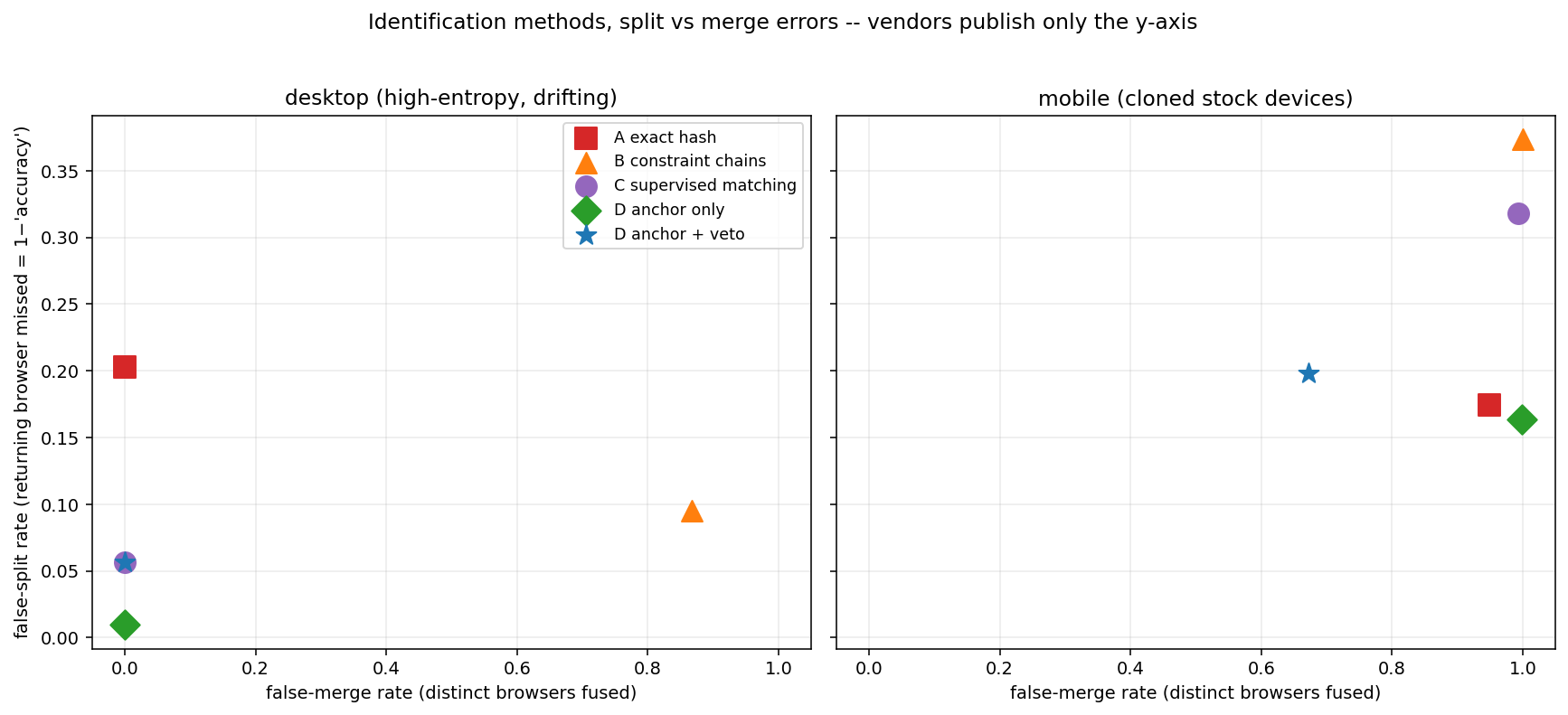
The numbers from this run, with each cell showing false-split / false-merge:
| Method | Evidence tier | Desktop | Mobile |
|---|---|---|---|
| A exact hash | documented | 0.203 / 0.000 | 0.174 / 0.949 |
| B constraint chains | reconstruction | 0.095 / 0.867 | 0.373 / 1.000 |
| C supervised matching | reconstruction | 0.057 / 0.000 | 0.318 / 0.993 |
| D anchor (recover only) | inference | 0.010 / 0.000 | 0.163 / 0.999 |
| D′ anchor + cookie veto | inference | 0.057 / 0.000 | 0.198 / 0.673 |
Five things fell out of building this, several of them not obvious in advance.
The exact hash trades pure split for pure merge. On desktop, Method A never merges (0.000) — distinctive font sets make every machine unique — but splits 20% of returning visits because any drift breaks the hash. On mobile the merge rate is catastrophic (0.949): clones share a hash by construction. This is the brittleness that motivates everything else.
The naive rule fixes splits by creating merges. Method B cut desktop splits to 0.095 but raised desktop merges to 0.867. The cause is structural and worth dwelling on: two different desktops sharing a template and GPU differ only in their font set, which is a single soft attribute, so a MAX_DIFFS of 2 happily fuses them. Drift tolerance and clone tolerance are the same dial when all soft attributes are weighted equally. FP-STALKER’s real rule engine avoids this by making specific attributes must-match; this deliberately naive version shows why that refinement is necessary rather than optional. The failure is left in rather than tuned away.
The learned matcher recovers the distinction the rule lost. Method C achieves desktop 0.057 split with 0.000 merge — drift tolerance without clone fusion. It manages this because it learned per-attribute weights from data rather than treating all soft attributes alike. The learned weights are interpretable and land where domain knowledge says they should:
fonts 3.61   screen 3.23   canvas 1.28   os_version 0.09
timezone -0.31   language -0.03   version-gap -2.12
Fonts and screen are near must-match; timezone and language carry almost no weight because in this population everyone shares them; a large version gap is evidence against a match. This is the experiment’s clearest argument for the ML variant over hand-written rules.
The vendor’s own ground-truth mechanism poisons the matcher on exactly the clone population. The threshold sweep for Method C is nearly flat from 0.2 to 0.8, then collapses at 0.95 — at which point every visit becomes its own ID, meaning even bit-identical fingerprints score below 0.95 and fail to link. The reason is the labelling: clone pairs (same fingerprint, different cookies) enter training as negative examples, because the cookie says “different browser.” The classifier therefore learns never to be fully confident that identical fingerprints are the same device — which is precisely the judgement it most needs on cloned hardware.
This labelling effect is a mechanism we observed on synthetic data, not a measured property of any real system. The direction is structural: any matcher trained on a deduplication signal (cookies) that itself fails on clones will inherit a blind spot on clones. The size of the effect here is an artifact of our chosen clone fraction and cookie-clear rate. We have not seen this stated explicitly in the public literature; treat it as a hypothesis the experiment generates, not a result it proves.
Only the deterministic anchor dents the mobile clone wall, and only when used as a veto. For Methods A, B, and C alike, mobile merge sits at 0.95–1.00: no method that looks only at browser content can separate identical inputs. Method D as pure recovery fixes splits (overall 0.086) but leaves mobile merges essentially untouched (0.999), because a merge happens before any cookie binds and is then permanent. The veto variant D′ rejects candidate chains carrying a different live cookie and cuts mobile merge to 0.673 — the residual being private-mode and freshly-cleared-cookie visits, which have no anchor to protect them. Note the cost: D′’s desktop split rose from 0.010 to 0.057, because after a legitimate cookie clear the veto blocks the correct re-link. Even the deterministic layer trades split against merge.
What this means for the account graph
The practical conclusion connects back to the identifier-graph experiment and its treatment of device_id as a clustering edge.
A vendor device-ID edge is heterogeneous evidence. Sometimes it is secretly a cookie edge — the deterministic anchor fired — which is strong. Sometimes it is a pure fingerprint match, which is much weaker. And on cloned mobile hardware the fingerprint half is close to worthless: a shared mobile device ID may mean two accounts are the same device, or merely two of ten million identical iPhones. If the vendor exposes a confidence or match-type signal alongside the ID, that signal should modulate the edge weight rather than being discarded — and in its absence, mobile-device-ID edges deserve heavier down-weighting than desktop ones, for the same inverse-frequency reasons that an identifier shared by fifty accounts is weaker than one shared by three.
The adversarial reading is the same asymmetry from the other side. An attacker who presents as a stock mobile gains real anonymity against the identification layer — that is what the 0.95 merge rate means. But that move does nothing against identifier-sharing or behavioural-synchrony clustering, and it trades against the consistency layer (a browser claiming to be mobile while its TLS stack and JS-engine quirks say otherwise is easier to flag) and the deterministic layer (statelessness defeats the anchor in both directions). No single layer is robust; the layers are valuable precisely because evading one tends to increase exposure on another.
How to read the outputs
| Output | Question it answers |
|---|---|
fp_methods_tradeoff.png |
For each method and device type, where does it sit on the split-versus-merge plane? |
| console: per-method split/merge | The same numbers as the table above, plus the desktop/mobile breakdown. |
| console: learned weights | Which attributes the supervised matcher relies on, and which it ignores. |
| console: threshold sweep | How Method C’s two errors move as the match threshold changes — and where it degenerates. |
The printed console output is part of the experiment, not a by-product. The per-device-type breakdown in particular is where the findings live; the overall numbers are dominated by the mobile clone floor and conceal the differences between methods on desktop.
What this demonstrates
This experiment supports a few limited claims:
- A fingerprint “ID” is a matching decision with two error modes, and the accuracy figure vendors publish describes only one of them.
- Drift and clones pull identification in opposite directions; reducing false splits tends to raise false merges unless attributes are weighted by their discriminative power.
- A learned matcher can separate these where a uniform rule cannot — but a matcher trained on cookie labels inherits a blind spot on exactly the cloned devices that are hardest to tell apart.
- Cloned mobile hardware sets a floor that no content-only method clears; only a deterministic anchor, used as a veto, moves it, and even that trades split against merge.
It does not measure any real vendor’s accuracy, real-world drift or clone rates, or adversarial effectiveness. The drift probabilities, the four-template mobile population, and the cookie-clear rate are all invented, and the mobile merge floor in particular is a direct consequence of those choices. Method B’s poor showing reflects a deliberately naive rule design, not FP-STALKER’s hand-tuned constraints — the honest reading is “uniformly-weighted rules lose to a learned matcher,” not “rules lose to ML in general.”
Reproducibility
python generate_fingerprints.py    # writes fp_visits.csv
python fp_methods.py               # runs A–D, prints metrics, writes the figure
The code shown on this page is readable pseudocode that follows the real logic step by step. The actual fp_methods.py vectorises the same operations — the linking loop scores all candidate chains for a visit in one batched call, and attributes are integer-encoded rather than compared as strings — which is faster but less legible. The behaviour is identical; the script is the source of truth for the numbers.
| Script | Reads | Writes |
|---|---|---|
generate_fingerprints.py |
none | fp_visits.csv |
fp_methods.py |
fp_visits.csv |
console metrics, images/fp_methods_tradeoff.png |
pandas/numpy: hold the visit log, encode attributes, reproducible random generation.scikit-learn: theLogisticRegressionpairwise matcher in Method C. Logistic regression is chosen over a heavier model on purpose — its coefficients are directly readable as per-attribute weights, which is the point being demonstrated. A production matcher would likely use gradient-boosted trees and lose that transparency.matplotlib: the static figure.
No graph library is needed here: unlike the identifier experiment, this is a sequential linking problem, not a projection-and-community-detection problem.
The linker compares each visit only to chains sharing its hard key, capped to the most recently active (CAND_CAP). This blocking step is not a toy shortcut — it is what every real matcher does, because exact all-pairs comparison is intractable at scale. At production volume the pairwise scoring is typically replaced by MinHash/LSH or an approximate nearest-neighbour index over fingerprint features, but the blocking-then-scoring shape is the same.
Possible extensions
- Population-frequency prior. The matcher currently compares a visit to one chain at a time. A globally rare fingerprint match is far stronger evidence than a stock-mobile match; adding an inverse-frequency prior on the match score is the same move as the identifier graph’s edge weighting, and would be the natural fifth method.
- Fingerprint-inconsistency detection. Model an attacker who spoofs a mobile UA while leaking a desktop TLS or JS-engine signature, and test whether a consistency check catches what identification cannot.
- Calibrated drift rates. Replace the invented per-day drift probabilities with values taken from a measured population, so the split rates become quantitatively, not just qualitatively, meaningful.
- Cost-weighted thresholds. Choose the Method C / D threshold to minimise a review-cost function (false merges into enforcement versus false splits into friction) rather than reporting the raw trade-off.